1月15日,美国科学促进会新闻网站(AAAS EurekAlert)和欧洲科学新闻(AlphaGalileo)两大有重要国际影响力的科学新闻媒体平台,报道了清华大学能源环境经济研究所张希良团队发表在Engineering的期刊文章“Role of Coal-to-Nuclear Conversion in China’s Electricity System Decarbonization”。该文章是清华大学中国碳中和促进项目(CCNI)下“小型模块化核反应堆(SMR)与我国电力热力零碳化研究”课题成果之一。论文共同第一作者为研究所李岱巍、张鸿宇博士,通讯作者为张希良教授。
以下为美国科学促进会新闻网站报道全文。美国科学促进会新闻网站和欧洲科学新闻文章链接如下:
https://www.eurekalert.org/news-releases/1112892
https://www.alphagalileo.org/en-gb/Item-Display/ItemId/267806
Engineering期刊公众号于1月8日也发表了题为《展望2060:核电占比或达22%,“煤改核”成中国电力脱碳关键变量 Engineering》的中文新闻稿,链接如下:
https://mp.weixin.qq.com/s/h4pGz87mw5-Afm8tBfdWJw
News Release 15-Jan-2026
Nuclear power projected to reach 22% in China by 2060, catalyzed by coal-to-nuclear conversion
Higher Education Press
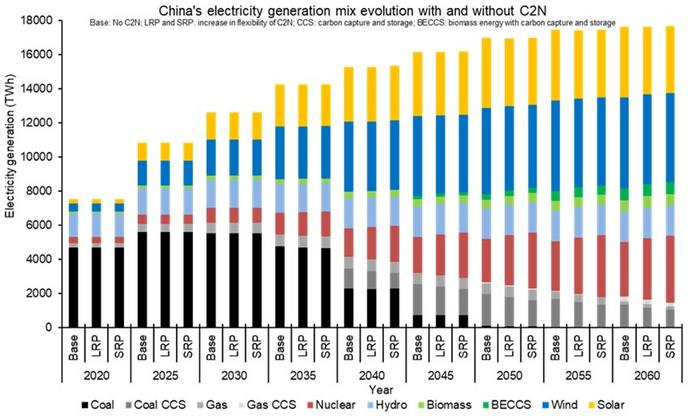
Image: Electricity generation mix evolution of three scenarios. Credit: Daiwei Li, Hongyu Zhang, et al.
Amid efforts to mitigate climate change, decarbonizing the power system has become a top priority. While the transition to non-fossil energy sources is accelerating in China, key challenges persist regarding the premature retirement of coal-fired power plants: the risks of asset stranding, the ongoing need for dispatchable firm power sources to ensure grid stability, and the need for a just transition in local employment and economic development. A recent study published in Engineering by Daiwei Li, Xiliang Zhang, and their colleagues from Tsinghua University offers a systematic evaluation of a promising solution: coal-to-nuclear (C2N) conversion, i.e. repowering the to-be-retired coal-fired power plants with nuclear power, particularly small modular reactors (SMRs).
To conduct the analysis, the research team improved a power system capacity expansion and operation model of China with provincial-level spatial resolution. By expanding its nuclear technology classification and incorporating specific constraints of C2N conversion, the team comprehensively assesses the technical and economic viability of this technology pathway in advancing China’s power system decarbonization goals.
The study suggests that, under China’s carbon peaking and neutrality goals, with the opening up of inland nuclear development, it could see substantial increase in the development of nuclear power—reaching 422 GW in installed capacity and accounting for 18% of China’s total electricity supply by 2060. The team further designed three scenarios to quantify how C2N development would impact nuclear installed capacity, their regional distribution, and total power system costs.
Scenario analysis results demonstrate that C2N conversion will unlock additional nuclear growth in China: repowering eligible retired coal power plants will expand nuclear sites and increase nuclear power capacity by 13%–23%, raising its share in China’s total electricity supply by 2–4 percentage points in 2060, reaching as high as 22%. This expansion is achieved without compromising China’s power system stability—maintaining a well-rounded mix dominated by non-fossil sources while renewable power curtailment rates kept below 7%. Notably, C2N conversion is particularly effective in facilitating SMR deployment in northwestern provinces with large coal power legacies. While supplemental to conventional greenfield nuclear sites, C2N enables nuclear power to be deployed across 28 provincial regions by 2060.
From an economic perspective, C2N conversion proves to be cost-effective. Between 2030 and 2060, the two C2N development scenarios will deliver cumulative cost savings of 0.22%–0.69% (0.44–1.39 trillion CNY) for the entire power system compared to the scenario without C2N. These savings stem from multiple factors: reduced investment in new nuclear development by leveraging existing coal plant sites and facilities, and optimized system operation where flexible SMRs installed via C2N displace unnecessary fossil-fuel-based generation, lowering overall operational costs.
Beyond the technical and economic insights, the study offers a few policy recommendations to support C2N development: prioritizing the protection of greenfield nuclear sites; promoting C2N pilot projects with supportive policies; expanding manufacturing capacity for key nuclear components; and supporting advanced nuclear technology R&D to lower costs and enhance operational flexibility. The implementation of these measures will well facilitate China’s power system transition.
This systematic analysis provides valuable guidance for policymakers and industry stakeholders committed to advancing power system decarbonization. By allowing for C2N conversion with diverse nuclear technologies, China and other countries facing similar coal transition challenges can mitigate asset stranding risks associated with traditional fossil fuel infrastructure while building a more cost-effective and low-carbon energy system.
The paper “Role of Coal-to-Nuclear Conversion in China’s Electricity System Decarbonization” is authored by Daiwei Li, Hongyu Zhang, Ying Zhou, Sheng Zhou, Siyue Guo, Junling Huang, and Xiliang Zhang, receiving supports by the National Natural Science Foundation of China (72140005 and 72374122) and the China Carbon Neutrality Initiative of Tsinghua University. Full text of the open access paper: https://doi.org/10.1016/j.eng.2025.11.025. For more information about Engineering, visit the website at https://www.sciencedirect.com/journal/engineering.